Saturday, September 29, 2012

How Is Christ like the Ark?

For the Son of Man has come to save that which was lost (Matthew 18:11).
As God’s Son, the Lord Jesus Christ is like Noah’s Ark. Jesus came to seek and to save the lost. Just as Noah and his family were saved by the Ark, rescued by God from the floodwaters, so anyone who believes in Jesus as Lord and Savior will be spared from the coming final judgment of mankind, rescued by God from the fire that will destroy the earth after the last days (2 Peter 3:7).

Noah and his family had to go through a doorway into the Ark to be saved, and the Lord shut the door behind them (Genesis 7:16). So we too have to go through a “doorway” to be saved so that we won’t be eternally separated from God. The Son of God, Jesus, stepped into history to pay the penalty for our sin of rebellion. Jesus said, “I am the door. If anyone enters by Me, he will be saved, and will go in and out and find pasture” (John 10:9).

(Reposted from Ken Ham & Tim Lovett, Was There Really a Noah’s Ark & Flood?, October 11, 2007, AnswersInGenesis.org)

(For historical fiction that touches on this topic, see Chapter 37: New Path of The Coming Wrath)

Discuss this post with us below, or here:

Did Noah’s father really die 5 years before the Flood?

In John K. Reed's book The Coming Wrath, Noah's father and grandfather both die shortly before the Flood. Lamech dies 5 years beforehand, and Methuselah less than a year. Is this just fiction, to make for a good story?

In the book of Genesis, the first book of the Bible, in chapter 5, we are given a detailed list of Adam and all his descendants, all the way up to Noah. We are told how long each lived, and how old they were when their sons were born. Genesis 11 continues with Noah and all of his descendants, up until Terah, the father of Abraham.

If you turn this into graphical form, you will get a graph like this:

Yes, Lamech and Methuselah were real men. According to the true testimony of the Bible, Lamech died 5 years before the Flood, and Methuselah one year beforehand. In his work of historical fiction, John K. Reed is faithful to this.

The Bible does not tell us how they died. Could it have happened the way it is portrayed in The Coming Wrath? You be the judge.

(For historical fiction that touches on this topic, see Chapter 23: Death Dream of The Coming Wrath)

Discuss this post with us below, or here:

For more info, see Bodie Hodge, Ancient Patriarchs in Genesis, Answers in Genesis, January 20, 2009.

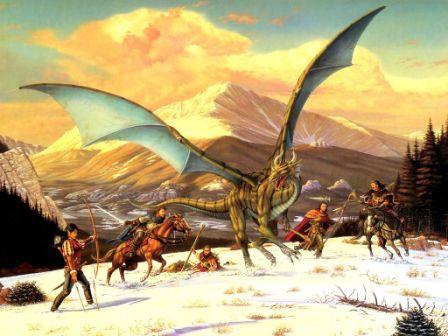
Dragons and Dinosaurs

The Chinese and over 200 other cultures have detailed stories about “dragons.” Why, if such creatures were only mythical beasts?

Hunting Dinosaurs after the Flood-
probably not Science Fiction!
It is generally agreed that “the current extinction crisis is caused primarily by human impacts upon wild populations,”1 and it is the largest, most dangerous wild creatures that are the first to go when humans move into an area. Thus, dinosaurs who came on board Noah's Ark and survived the Flood likely went extinct gradually the same way that scientists today observe extinctions.

Those who claim that dinosaurs could not have fit on the Ark might recall that the average dinosaur size was on the order of that of a large dog. Even the massive dinosaurs started out from football-size eggs, and juveniles of these groups could have easily been selected to board the life-saving vessel.

What about the descendants of the dinosaurs that stepped off the Ark after their year-long stay? Again, eyewitness evidence confirms that dinosaurs lived for centuries after the Flood.

St. George had to deal with a dragon in England. Alexander the Great’s army encountered a dragon. Marco Polo recorded dragon dealings. Flavius Philostratus provided this sober account in the third century A.D.:
The whole of India is girt with dragons of enormous size; for not only the marshes are full of them, but the mountains as well, and there is not a single ridge without one. Now the marsh kind are sluggish in their habits and are thirty cubits long, and they have no crest standing up on their heads.2
Pliny the Elder also referenced large dragons in India in his Natural History. More recently, historian Bill Cooper described many ancient news accounts of dinosaur encounters from England and Europe, which to this day contain place names that reference the dragons that were once there, like “Knucker’s Hole,” “Dragon-hoard,” and “Wormelow Tump.”3

Similar accounts have been handed down orally within North, Central, and South American Indian groups. The fact that so many different peoples told the same details authenticates their testimony. The book Fossil Legends of the First Americans relays information about anatomy, habitat, and hero tales related to “a water monster that ‘grew so huge’ (p. 29), a Pawnee giant raptor called Hu-huk (p. 189), a Yuki story of giant lizards that ‘were so huge that they shook the earth’ (p. 208), Sioux legends of thunderbirds (p. 239), and many other legends.”4

How did mankind handle post-Flood dinosaur encounters? Most likely, the dinosaurs were eliminated by humans trying to protect themselves. This is a common theme in the many dragon legends. 

(for the complete article, see Brian Thomas and Frank Sherwin, Eyewitnesses to Extinction, Testimonies to the Life and Death of Dinosaurs, Acts & Facts, June 2011)

(For historical fiction that touches on this topic, see Chapter 21: Uphill Battle of The Coming Wrath)

Discuss this post with us below, or here:

References (selected)

1. Woodroffe, R. 2000. Predators and people: using human densities to interpret declines of large carnivores. Animal Conservation. 3 (2): 165-173

2. Flavius Philostratus (c170-c247 A.D.). 1912. The Life of Apollonius of Tyana, volume I, book III. F. C. Conybeare, trans. New York: Macmillan Co., 243-247. 

3. Cooper, B. A. 1995. After the Flood. Chichester, UK: New Wine Press, 130-145. Available online at ldolphin.org/cooper.

4. Thomas, B. 2010. Oblivious to the obvious: dragons lived with American Indians. Journal of Creation. 24 (1): 33. This is a book review of Mayor, A. 2005. Fossil Legends of the First Americans. Princeton, NJ: Princeton University Press.

Friday, September 28, 2012

Slavery before the Flood?

In The Coming Wrath, the first book of the Lost Worlds Trilogy, the warlord Delonias captures twelve Nephilim boys in battle to become slaves. He sends the most promising one, Sechiall, to Jared. Is it realistic that slavery as an institution was already established before the Flood of Noah's day?

Let us consider the most ancient written historical records that are available to us.

In ancient Babylon, in the land of Mesopotamia (currently Iraq), "The Code of Hammurabi, from Babylon in the 18th century BC, gives chilling details of the different Rewards and penalties for surgeons operating on free men or slaves."1

Egyptian slaves
In ancient Egypt, from the very 1st dynasty before the year 2000 BC, "Hem (Hm), generally translated as 'slave' and originally meaning body, was seemingly a person with lessened rights dedicated to a certain task such as the service of a god or the royal administration."2,3

In ancient India, "the institution of slavery originated in India when the Aryans captured a number of dasas in the battle. According to Mahabharata it is a law of war that the vanquished should become slave of the victor and should serve his captor until ransomed. In course of time certain other categories of slaves also came into existence. For-example children born to a slave automatically became the slaves of the same masters."4

In ancient China, "Slaves occupied a large portion of the population in ancient China since 2,100 BC, when Xia Dynasty started."5

Thus we see from the earliest records of the great civilizations, slavery was an evil presence in all of them. Is there somewhere a common thread here?

Yes! The Bible supplies us with many valuable clues, that historians ignore at the detriment of their own profession.

There are two events that the Bible records in detail which occurred before all of these ancient civilizations. They are the global Flood of Noah's day, and only four generation later, the Tower of Babel. The book of Genesis tells us about the worldwide flood which Noah, his family of eight, and all land creatures survived through God's provision of the Ark. Noah's, his three sons, Shem, Ham and Japheth, and their wives lived on to tell the next generations many true stories about what the world was like before the Flood.

Tower of Babel?
Nimrod, the grandson of Ham, was a mighty ruler who built great cities in the land of Mesopotamia, among them Babylon (also known as Babel), Uruk, Akkad and Kalneh, in the area of Shinar, and Nineveh, Rehoboth Ir, Calah and Resen in the area of Assyria (Genesis 10:9-11). By this time, most of the newer generations no longer had faith in the Creator God in the way Noah and his family did. Instead, they followed Nimrod. They "wanted to make a name for themselves." As told in the Bible's book of Genesis chapter 11, at the city of Babel which Nimrod built:
They said to each other, “Come, let’s make bricks and bake them thoroughly.” They used brick instead of stone, and tar for mortar. Then they said, “Come, let us build ourselves a city, with a tower that reaches to the heavens, so that we may make a name for ourselves; otherwise we will be scattered over the face of the whole earth.”

But the Lord came down to see the city and the tower the people were building. The Lord said, “If as one people speaking the same language they have begun to do this, then nothing they plan to do will be impossible for them. Come, let us go down and confuse their language so they will not understand each other.”

So the Lord scattered them from there over all the earth, and they stopped building the city. That is why it was called Babel —because there the Lord confused the language of the whole world. From there the Lord scattered them over the face of the whole earth. (Genesis 11:3-8)
The Tower of Babel account explains many things. Shortly afterward we see four separate advanced civilizations springing up: in Babylon, Egypt, India, and China. All of them had slavery! Though God confused their languages, he did not take away their memory. It is likely that the Tower of Babel itself was built by slave labor (!), spurred on by the leadership of men such as Nimrod.

Did Nimrod and his followers come up with the idea of slavery themselves? Perhaps. But it is extremely likely that they heard all about slavery and the evils that resulted from it from their forefathers Shem, Ham, and Japheth, and from Noah himself who was still alive at the time. (From clues in Chinese history, after the Tower of Babel incident, Noah with one of the scattered groups to China, and lived out the remainder of his years there.6)

Genesis chapter 6 paints a brief picture of the world prior to the Flood. We are told "The Lord saw how great the wickedness of the human race had become on the earth, and that every inclination of the thoughts of the human heart was only evil all the time." (Genesis 6:5). The fact that slavery was an integral part of the earliest historic civilizations in Babylon, Egypt, India, and China, points to the presence of slavery before the Flood. Slavery was very likely one huge area of the "wickedness of the human race" that brought the Flood judgment upon them.

Yet God extended his grace and mercy to Noah and his family, knowing that their descendants Nimrod and his adversaries would hear about the evil of slavery before the Flood, and like the idea! Knowing that the Tower of Babel would be built by slaves. Knowing that wickedness would once again be widespread upon the earth?! This is the topic of Mystery of Lawlessness, the third book of the Lost Worlds Trilogy.

God extends his grace and mercy to sinful people today, if they turn to him in repentance and accept the give of Jesus Christ's sacrifice on the cross for our behalf. This makes this all so extremely relevant to people of every day and age, including for us today.

(For historical fiction that touches on this topic, see Chapter 7: Protégé of The Coming Wrath)

Discuss this post with us below, or here:

written by Marko Malyj

References 

1. History of Slavery, An Evil of Civilization, History World, retrieved 1/16/2013.

2. Slavery in Ancient Egypt, An introduction to the history and culture of Pharaonic Egypt, retrieved 1/16/2013.

3. Jimmy Dunn, Slaves and Slavery in Ancient Egypt , http://www.touregypt.net/featurestories/slaves.htm, retrieved 1/16/2013.

4. Srouti Modha, Essay on system of slavery in Ancient India, retrieved 1/16/2013.

5. Slavery in Ancient China, Slaveryinjustice blog, retrieved 1/16/2013.

6. Roy L. Hales, Archaeology, The Bible and The Post-Flood Origins of Chinese History, retrieved 1/26/2013.

Thursday, September 27, 2012

Were Dinosaurs on Noah’s Ark?

The history of God’s creation (told in Genesis 1 and 2) tells us that all the land-dwelling creatures were made on Day 6 of Creation Week—the same day God made Adam and Eve. Therefore, it is clear that dinosaurs (being land animals) were made with man.

Also, two of every kind (seven of some) of land animal boarded the Ark. Nothing indicates that any of the land animal kinds were already extinct before the Flood. Besides, the description of “behemoth” in chapter 40 of the book of Job (Job lived after the Flood) only fits with something like a sauropod dinosaur. The ancestor of “behemoth” must have been on board the Ark.1

We also find many dinosaurs that were trapped and fossilized in Flood sediment. Widespread legends of encounters with dragons give another indication that at least some dinosaurs survived the Flood. The only way this could happen is if they were on the Ark.

Models of juvenile dinosaurs at Creation Museum
Juveniles of even the largest land animals do not present a size problem, and, being young, they have their full breeding life ahead of them. Yet most dinosaurs were not very large at all—some were the size of a chicken (although absolutely no relation to birds, as many evolutionists are now saying). Most scientists agree that the average size of a dinosaur is actually the size of a sheep.

For example, God most likely brought Noah two young adult sauropods (e.g., apatosaurs), rather than two full-grown sauropods. The same goes for elephants, giraffes, and other animals that grow to be very large. However, there was adequate room for most fully grown adult animals anyway.

As far as the number of different types of dinosaurs, it should be recognized that, although there are hundreds of names for different varieties (species) of dinosaurs that have been discovered, there are probably only about 50 actual different kinds.

(Reposted from Ken Ham & Tim Lovett, Was There Really a Noah’s Ark & Flood?, October 11, 2007, AnswersInGenesis.org)

(For historical fiction that touches on this topic, see Chapter 36: Migration of The Coming Wrath)

Discuss this post with us below, or here:

Reference

1. For some remarkable evidence that dinosaurs have lived until relatively recent times, see chapter 12, “What Really Happened to the Dinosaurs?” Also read The Great Dinosaur Mystery Solved, New Leaf Press, Green Forest, Arkansas, 2000. Also visit www. answersingenesis.org/go/dinosaurs.

Monday, September 24, 2012

How Could Noah Round Up So Many Animals?

"Of the birds after their kind, of animals after their kind, and of every creeping thing of the earth after its kind, two of every kind will come to you, to keep them alive." (Genesis 6:20)
This verse tells us that Noah didn’t have to search or travel to far away places to bring the animals on board. The world map was completely different before the Flood, and on the basis of Genesis 1, there may have been only one continent. The animals simply arrived at the Ark as if called by a “homing instinct” (a behavior implanted in the animals by their Creator) and marched up the ramp, all by themselves.

Though this was probably a supernatural event (one that cannot be explained by our understanding of nature), compare it to the impressive migratory behavior we see in some animals today. We are still far from understanding all the marvelous animal behaviors exhibited in God’s creation: the migration of Canada geese and other birds, the amazing flights of Monarch butterflies, the annual travels of whales and fish, hibernation instincts, earthquake sensitivity, and countless other fascinating capabilities of God’s animal kingdom.

(Reposted from Ken Ham & Tim Lovett, Was There Really a Noah’s Ark & Flood?, October 11, 2007, AnswersInGenesis.org)

(For historical fiction that touches on this topic, see Chapter 36: Migration of The Coming Wrath)

Discuss this post with us below, or here:

Sunday, September 23, 2012

How Could Noah Fit All the Animals on the Ark?

And of every living thing of all flesh you shall bring two of every sort into the ark, to keep them alive with you; they shall be male and female (Genesis 6:19).
In the book Noah’s Ark: A Feasibility Study1, creationist researcher John Woodmorappe suggests that, at most, 16,000 animals were all that were needed to preserve the created kinds that God brought into the Ark.

The Ark did not need to carry every kind of animal—nor did God command it. It carried only air-breathing, land-dwelling animals, creeping things, and winged animals such as birds. Aquatic life (fish, whales, etc.) and many amphibious creatures could have survived in sufficient numbers outside the Ark. This cuts down significantly the total number of animals that needed to be on board.

Another factor which greatly reduces the space requirements is the fact that the tremendous variety in species we see today did not exist in the days of Noah. Only the parent “kinds” of these species were required to be on board in order to repopulate the earth.2 For example, only two dogs were needed to give rise to all the dog species that exist today.

Woodmorappe's suggestion for smaller animal cages
that would be suitable for animals such as rodents,
modeled by Arnold Mendez3
Creationist estimates for the maximum number of animals that would have been necessary to come on board the Ark have ranged from a few thousand to 35,000, but they may be as few as two thousand if the biblical kind is approximately the same as the modern family classification.

As stated before, Noah wouldn’t have taken the largest animals onto the Ark; it is more likely he took juveniles aboard the Ark to repopulate the earth after the Flood was over. These younger animals also require less space, less food, and have less waste.

Using a short cubit of 18 inches (46 cm) for the Ark to be conservative, Woodmorappe’s conclusion is that “less than half of the cumulative area of the Ark’s three decks need to have been occupied by the animals and their enclosures.”4 This meant there was plenty of room for fresh food, water, and even many other people.

(Reposted from Ken Ham & Tim Lovett, Was There Really a Noah’s Ark & Flood?, October 11, 2007, AnswersInGenesis.org)

(For historical fiction that touches on this topic, see Chapter 19: Dark Vessel of The Coming Wrath)

Discuss this post with us below, or here:

References

1. J. Woodmorappe, Noah’s Ark: A Feasibility Study, Institute for Creation Research, Santee, California, 2003

2. Here’s one example: more than 200 different breeds of dogs exist today, from the miniature poodle to the St. Bernard—all of which have descended from one original dog “kind” (as have the wolf, dingo, etc.). Many other types of animals— cat kind, horse kind, cow kind, etc.—have similarly been naturally and selectively bred to achieve the wonderful variation in species that we have today. God “programmed” this variety into the genetic code of all animal kinds—even humankind! God also made it impossible for the basic “kinds” of animals to breed and reproduce with each other. For example, cats and dogs cannot breed to make a new type of creature. This is by God’s design, and it is one fact that makes evolution impossible.

3. Tim Lovett, An Ark full of Nests, WorldWideFlood.com, June 2007.

4. Woodmorappe, Noah’s Ark: A Feasibility Study, 16.